

Market Aligned and Bipartisan



Governor Newsom signs first-of-its-kind executive order to prepare workers and businesses for potential AI disruption
California is preparing workers and businesses for the growing impact artificial intelligence could have on the workforce and broader economy. Governor Gavin Newsom recently signed an executive order focused on studying potential job disruption, workforce adaptation, and the long term effects of AI across industries. The order reflects a growing recognition among policymakers that technological change is accelerating and that states will need strategies to provide a stronger economic safety net during workforce disruption
As automation and artificial intelligence continue reshaping industries, conversations around long term economic stability are becoming increasingly important. Universal Income would help workers remain financially stable through workforce disruption while ensuring Americans continue benefiting from the economic value created through technological progress.

Meta layoffs starting this week stress harsh AI reality inside Zuckerberg’s company
Meta is laying off roughly 10% of its workforce while continuing to expand investments in artificial intelligence infrastructure and development. According to CNBC, the reductions are expected to impact around 8,000 employees, with additional layoffs potentially planned later this year as the company restructures around efficiency and long term AI growth. Employees across the tech sector are facing growing uncertainty as companies increasingly reorganize operations around automation and artificial intelligence.
The layoffs reflect a broader shift taking place throughout the economy, where advances in technology are allowing companies to increase productivity with fewer workers. Universal Income would provide stability through that transition while helping ensure Americans continue to benefit from the long term economic value created through technological progress.

Coinbase Cuts 14% of Jobs Amid AI Disruption
Coinbase is laying off roughly 14% of its workforce as artificial intelligence changes how work is done across the tech and crypto sectors. According to Gizmodo, CEO Brian Armstrong cited the company’s expanding use of AI tools as reasons behind the cuts, saying AI has accelerated workflows that once required far larger teams. Workers who helped grow these companies are increasingly being left out of the value those systems continue to generate.
The layoffs reflect a broader shift across the economy, where AI-driven efficiency is allowing companies to do more with fewer people. Universal Income would keep people financially stable through that transition, while making sure Americans continue to benefit from the economic value their work helped create.

Meta Cuts 10% of Jobs as AI Drives Efficiency
Meta is laying off 10% of its workforce as artificial intelligence reshapes how work gets done. In coverage from The New York Times, company leadership acknowledged the trade-offs behind these decisions: “This is not an easy trade-off and it will mean letting go of people who have made meaningful contributions to Meta during their time here.” Workers who helped build today’s most valuable companies are becoming increasingly disconnected from the gains those systems now produce.
The cuts reflect a broader shift across the tech sector, where AI-driven efficiency is reducing the need for certain roles even as overall output grows. Universal Income offers a clear path forward, providing stability and ensuring the value created over time is shared with the people who helped generate it.
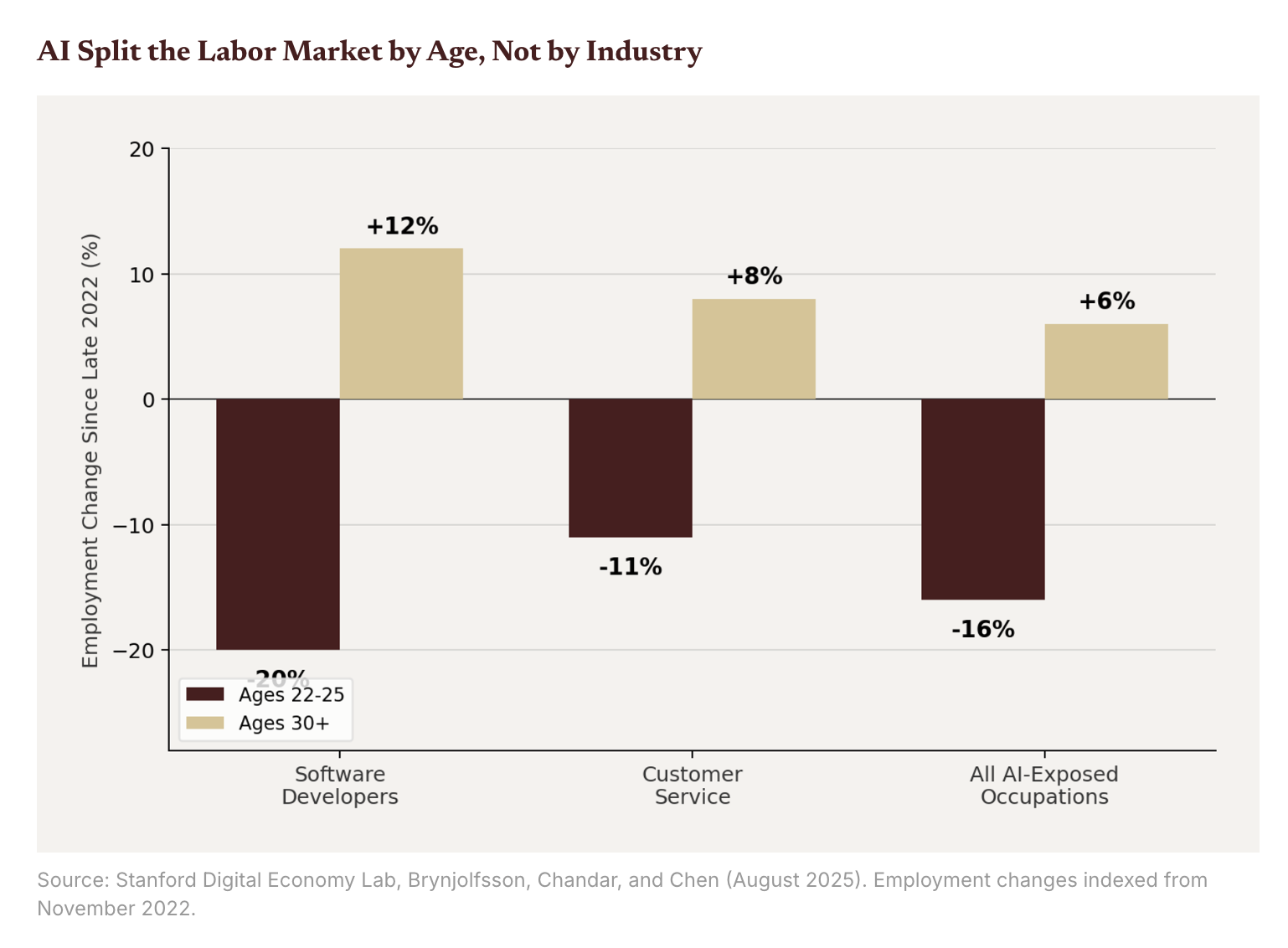
AI Is Closing the Door on Entry-Level Work
Research out of Stanford shows AI is reshaping hiring faster than the labor market can adjust. Since late 2022, employment for workers aged 22-25 has declined across AI-exposed roles like software development and customer service, while older workers have continued to see gains. As companies use AI to handle routine tasks, they are pulling back on entry-level hiring and relying more on experienced workers, leaving fewer pathways for young people to enter the workforce.
Technology will keep advancing, and the systems around it need to adapt just as quickly. As AI-driven productivity reduces access to early-career roles, ensuring Americans can still participate in economic growth will be critical. Universal Income is a clear path forward, providing stability and ensuring the gains from AI reach Americans nationwide.

The AI Economy Is Expanding. Who Benefits?
A new report highlights how AI leaders are beginning to confront the economic impact of rapid technological change. As artificial intelligence drives new productivity, concerns are growing about job disruption and the concentration of wealth among a small group of companies and investors.
Technology will keep advancing, but the systems around it need to adapt just as quickly. As AI-driven growth outpaces traditional income structures, ensuring Americans benefit from economic growth will be critical. A Universal Income is a clear path forward, providing stability and ensuring the gains from AI reach Americans nationwide.

China’s AI Challenge Is Becoming an Economic Reality
A new report highlights growing pressure inside China as artificial intelligence begins to reshape its economy. Slowing growth, deflation, and rising automation are forcing leaders to confront a difficult reality. As jobs become less stable and traditional industries weaken, even a system built on control may need to expand its social safety net to maintain stability.
Technology will keep advancing, but the economic systems around it need to adapt just as quickly. When AI-driven productivity outpaces job creation, households feel the impact first. A Universal Income would help provide a foundation of financial stability, ensuring people can navigate economic shifts as the workforce continues to evolve.

As AI Accelerates, Concerns About Jobs and Inequality Grow
Entrepreneur and investor Roger Montgomery is warning that artificial intelligence is advancing faster than society is prepared to handle. As AI capabilities grow, concerns are rising about its potential to disrupt jobs, concentrate economic power, and outpace the systems meant to manage its impact.
Technology will continue to move forward, but economic structures need to keep up. As AI drives new levels of productivity, ensuring those gains are more widely shared will be critical. A Universal Income would help provide stability as the economy adjusts, ensuring households are not left behind as these changes unfold.

HSBC Plans Tens of Thousands of Job Cuts as AI Changes Banking
HSBC is reportedly considering cutting around 20,000 jobs as artificial intelligence reshapes banking operations. HSBC, led by CEO Georges Elhedery, is simplifying its structure and trimming roles to boost efficiency. These planned reductions highlight a broader trend: AI is moving from experimentation to real workforce disruption.
Technology should continue to advance, but economic systems must keep pace. An AI-driven Universal Income would help ensure the gains from automation reach households, protecting workers as the labor market evolves.
Andrew Yang Warns AI Could Trigger Mass Job Displacement
Entrepreneur and former presidential candidate Andrew Yang is raising new concerns about how quickly artificial intelligence will reshape the labor market. As companies move beyond testing AI and begin integrating it into core operations, Yang warns that large-scale job displacement could arrive faster than many policymakers expect.
Innovation should continue, but economic systems need to keep pace with technological change. Yang has argued that part of the wealth created by AI-driven productivity should be redirected back to the public through a Universal Income. As the workforce evolves, ensuring that the gains from automation reach households, not just technology owners, will be critical.

AI Layoffs Are No Longer Theoretical
A recent report is sounding new alarms about what artificial intelligence could mean for the job market. Companies are beginning to openly link layoffs and restructuring to AI adoption, suggesting the shift from experimentation to real workforce disruption may already be underway. What once sounded like a distant concern is starting to show up in corporate decisions about how many workers companies actually need.
Technology should continue to advance, but when productivity gains arrive faster than economic systems can adapt, workers absorb the shock. An AI dividend trust fund that supports a Universal Income would help ensure the economic gains from AI strengthen household stability as the labor market evolves. If the warning signs are already appearing, policy should not wait to respond.

Preparing for AI-Driven Job Disruption
JPMorgan Chase CEO Jamie Dimon is warning that AI-driven job disruption could hit faster and harder than many expect. He pointed to millions of workers, including truck drivers earning around $120,000 per year, who could face steep income losses if automation replaces their roles. A drop from six-figure earnings to $25,000 jobs would not just hurt individuals. It would destabilize families and communities.
Dimon argues that technology should not be stopped, but transitions must be managed carefully. When AI adoption outpaces economic planning, workers absorb the shock. A permanent AI dividend fund that supports a Universal Income would help ensure productivity gains strengthen household stability as the labor market evolves. If disruption is foreseeable, preparation should be too.

AI Is Already Disrupting the Young Workforce
Federal Reserve Governor Michael Barr warns that artificial intelligence is no longer a distant economic threat. It is already affecting young U.S. workers. Entry-level roles in areas like software development and customer service are beginning to thin out as AI systems take on tasks that once served as career starting points. The concern is not theoretical anymore, early-career workers are facing a labor market that is shifting faster than they can adapt.
When AI adoption moves faster than our education systems, hiring pipelines, and safety nets, workers absorb the shock. An AI dividend trust fund to support a Universal Income would help ensure that the economic gains from AI support household stability as the labor market evolves. If disruption is already here, policy should not lag behind it.

AI Is Scaling Faster Than Our Economic Systems
Former U.S. Congressman Mark Kennedy describes how AI development is expanding globally, with countries like India quickly building the infrastructure, compute capacity, and technical ecosystems needed to deploy AI systems at scale. His point is that the story is no longer just about model breakthroughs. It is about how fast countries are building the capacity to actually use AI across industries.
That pace has real economic consequences. As AI systems spread into more parts of the economy, we know that workforce disruption is going to follow. An AI dividend trust fund to support a Universal Income would help make sure AI-driven growth supports household stability as the labor market evolves.
AI Boom Reshapes Tech Giants and Cybersecurity
Recent reporting shows the AI boom is rapidly reshaping major tech companies and cybersecurity, with billions flowing into AI systems, infrastructure, and automation tools. Corporate priorities are shifting quickly as AI becomes central to how firms operate and scale.
As AI investment accelerates and concentrates economic gains, Congress should establish an AI dividend trust fund and use it to support a Universal Income for every American, so the value created by AI helps strengthen household economic security.

Amazon Lays Off 16,000 as AI Reshapes the Workforce
Recent Reuters reporting shows Amazon cutting 16,000 jobs as part of a global restructuring tied to efficiency and expanded use of artificial intelligence. This is another clear signal that major companies are reorganizing around AI and automation, reducing headcount while investing in new technology.
Congress should establish an AI dividend trust fund and use it to support a Universal Income for every American, so the gains from AI productivity support people and profits.

The Twin Cities Economy Is Entering the AI Era
Recent reporting on the Twin Cities economy shows that artificial intelligence is no longer a future concern. Across healthcare, manufacturing, finance, and energy, AI is already reshaping how work gets done, creating new efficiencies while quietly changing the structure of jobs and economic security.
As this transformation accelerates, policymakers must consider a Universal Income as a serious policy response to the quiet growth of AI-driven job disruption.

A Workforce With No On-Ramp
Recent findings from Microsoft highlight a growing divide in how countries and workers experience AI. As automation spreads unevenly, job security is becoming less predictable, especially for younger workers entering the workforce.

The College-to-Office Path Is Breaking
According to the CEO of the world’s largest recruiting firm, the traditional path from college to an office job is no longer reliable. Automation and AI are reducing entry-level roles and forcing younger workers to reconsider career paths.

Entry-Level Jobs Are Disappearing
Experts warn that AI is increasingly replacing entry-level tasks, reducing opportunities for recent graduates to gain early career experience. The trend raises concerns about how young workers enter the workforce.